

The homes of 200 million people will be below sea level in 70 years ...
Introducing LEAD.ai
Introducing L.E.A.D. Most emissions reduction methodologies are still evolving and testing the waters. Ours combines the essential elements needed to reduce greenhouse gas (GHG) emissions — Lowering Emissions by Applied Design — now powered by AI. Each stage has a distinct goal and a clearly defined measure of success aligned to your objectives, with AI tools and our industry-trained models accelerating every step. The approach is agile, collaborative and flexible to your financial capacity, and we partner with specialised consulting and technology partners where required
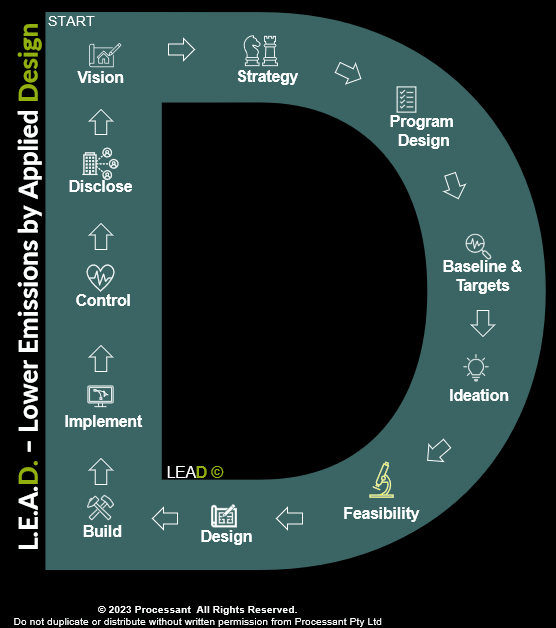
Foundation, Design and Change are the key pillars of L.E.A.D.
We support businesses in meeting the AASB Climate-related Financial Disclosures requirements by applying AI-enabled data analytics, technology implementation, and process transformation. Using AI tools and models throughout, our approach is structured around the four AASB pillars:
Governance: We use AI to help establish clear oversight and accountability structures for climate-related risks and opportunities.
Strategy: We apply AI tools and models to evaluate operational impacts and identify strategic opportunities to reduce emissions, embedding AI directly into climate risk management.
Risk Management: We design and implement AI-enabled frameworks to assess, monitor, and manage climate-related risks across the enterprise.
Metrics & Targets: We harness AI alongside our applied design methodology (L.E.A.D.) to track performance and set actionable emissions reduction goals.
Through this AI-enabled approach, we empower organisations to streamline processes, reduce environmental impact, and enhance climate resilience.
Vision & Strategy
Program Design
Baseline & Targets


Having a compelling vision and strategy is crucial for aligning everyone in the organisation towards the same goals. We use AI to help you develop a compelling sustainability vision, drawing on models we've trained on numerous sustainability reports across industries. With this AI-powered expertise, we ensure your vision is both inspiring and achievable, benchmarked against best practice and guiding your team towards success. Our AI-enabled strategies create a clear roadmap, enabling your organisation to navigate challenges and seize opportunities. By combining proven practice with intelligent insight, we help you create a unified, focused workforce — a compelling vision that drives your organisation forward and sets you apart from the competition.
In this stage, we use AI to set you up for success through a well-designed program. This involves establishing a governance structure, decision-making rights, and effective risk management mechanisms, with AI helping to identify and manage risks efficiently to ensure smooth operations. Our models, trained on sustainability reports across industries, surface where roles and responsibilities need clarity, so everyone understands their tasks and obligations. By implementing a robust, AI-enabled program design, we provide the foundation necessary for achieving your goals and objectives.
In this stage, AI helps us collect and interpret data from your operational processes to gain a comprehensive understanding of your current performance. Our models — trained on numerous sustainability reports across industries — let you rapidly assess strengths and weaknesses and identify areas for improvement. AI also checks your data against regulatory and stakeholder obligations to ensure you're meeting all necessary requirements. By analysing this information together, we set clear, evidence-based targets and goals for your future state design. These targets serve as a roadmap, guiding efforts towards optimal performance and meeting stakeholder needs. Through this AI-enabled, systematic approach, we continuously improve and enhance your operations.
Pillar 2: Design
The process starts collaborate with stakeholders and experts, gathering diverse perspectives and generating innovative ideas at speed. Our models, trained on industry best practices, keep us informed about the latest trends and approaches. AI helps us think beyond the obvious — surfacing unconventional solutions that can bring significant benefits. We then run an AI-supported prioritisation and feasibility analysis to determine which ideas are most viable and aligned with your goals. This accelerates informed decisions and focuses development on solutions that are practical and achievable. By following this AI-enabled process, we build a solution that not only meets your goals but also addresses the needs and requirements of all stakeholders.
Build
Ideation & Feasibility
Applied Design






We actively engage your teams to brainstorm ideas that directly pertain to Scope 1, Scope 2, and Scope 3 emissions. By involving your teams, we tap into their diverse perspectives and expertise to generate a wide range of innovative ideas. These ideas form the foundation for our subsequent steps. We then thoroughly assess the feasibility of each idea, conducting a factual analysis to ensure its viability. To ensure that our analysis is comprehensive and aligned with industry standards, we overlay the ideas with industry best practices. This approach allows us to identify the most feasible ideas that have the potential to significantly reduce your emissions. By involving your teams and considering industry best practices, we ensure that the ideas we develop are not only creative but also practical and achievable.
To convert an idea into a practical design document that caters to all stakeholders, a systematic approach is crucial. This phase involves consultations with various stakeholders to gather their inputs and ensure their needs are considered. After gathering all necessary information, the design document or wireframes are created, outlining the project's scope, timelines, and deliverables. This document acts as a blueprint, guiding the implementation process and ensuring that the final product meets the expectations of all stakeholders. Clear communication throughout the process is vital to ensure transparency and alignment among the team. By following this approach, ideas can be transformed into practical designs that benefit all parties involved.
We collaborate closely with your developers to effectively manage and oversee the implementation of technology solutions that align with the needs of stakeholders. As product owners and agile leads, we take charge of ensuring that the teams work in an efficient and productive manner. We are committed to addressing any queries or concerns promptly, enabling a smooth and seamless development process. Our aim is to ensure that the final product meets all stakeholder requirements and delivers optimal results. With our expertise in project management and deep understanding of technology, we are dedicated to facilitating a successful outcome.
Pillar 3: Change
Once a design is implemented, it is crucial to continuously review and monitor its performance. This ensures that the desired outcomes are achieved and any necessary adjustments can be made. It is important to report the outcomes accurately and consistently, following the regulatory requirements. Stakeholders, including both internal and external parties, should be informed and educated whenever necessary. By keeping all stakeholders well-informed, they can understand the progress and impact of the implemented design, making it easier to align their expectations and provide relevant feedback. This ongoing review, monitoring, reporting, and communication process ensures that the design remains effective and meets the needs of all stakeholders.


Once the design takes form, we ensure that it integrates well within the organisation. This includes preparing for the go-live phase by ensuring readiness and communicating effectively with the various areas that will be impacted, allowing for a seamless transition and optimal functionality.
During the control stage, measures are implemented to ensure that the planned process operates seamlessly. This involves profiling of data, monitoring data quality and addressing any issues that arise. We ensure that controls are automated and proactive where possible.
During the disclose stage, it is essential to provide the necessary reports to both management and regulators. These reports serve to inform them about the progress made in a transparent and accountable manner. Additionally, communication plays a crucial role in this stage as it ensures that the entire organisation is aware of the progress being made. This fosters a sense of unity and shared responsibility.
Implement
Control
Disclose
