
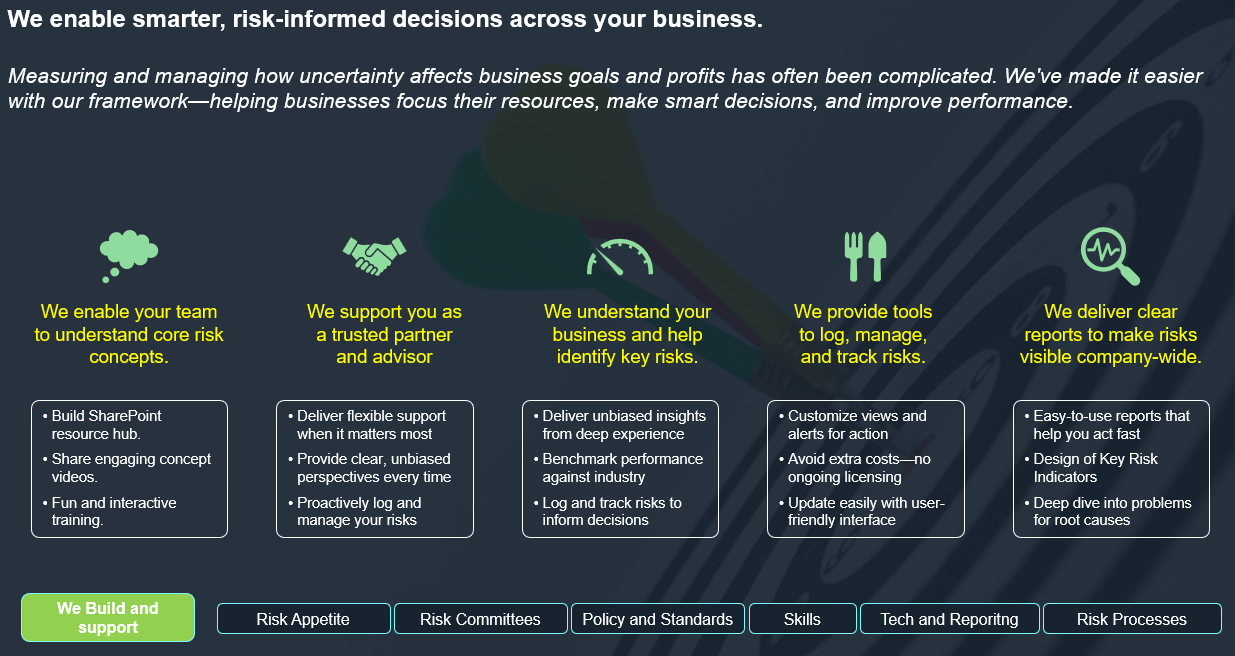
We enable smarter, risk-informed decisions across your business. Measuring and managing how uncertainty affects your goals and profits has always been complicated. AI makes it easier. Our AI-enabled framework cuts through the noise — helping you focus resources where they matter, make confident decisions faster, and lift performance across the business.
Risk Management for Success — Simple · Practical · Scalable Aligned to ISO 31000 & COSO ERM
Most risk frameworks are heavy to run and quick to go stale. Ours is different. Processant's proprietary risk methodology is built on years of consulting practice and proven in real businesses — and we now run it with AI at every stage, drawing on models we've trained across industries. The result is risk management that's faster to stand up, easier to live every day, and genuinely 360°: it tells you what could go wrong, why it happens, and how bad it would be.
Crucially, we manage two kinds of risk at once — the risk to your business, and the risk introduced by AI itself. As data governance specialists, we make sure the data feeding every model is trustworthy before a single recommendation is made.
Our Approach in One Line
We connect people, process, technology and AI to surface risks before they become incidents, give leaders confident, evidence-based decisions, and embed risk thinking into everyday operations — owned by leadership, lived by all staff.
The Methodology — Six Stages, AI Throughout1. Set the Foundation — Scope, Context & Criteria
ISO 31000 Cl. 6.3
No two organisations are the same, so we begin by defining what you're managing risk for (strategic, operational, programmatic and project levels), the environment you operate in, and the criteria by which risk is measured.
Where AI works: Our models scan your external context — regulation, market, policy — and benchmark your risk criteria against patterns we've learned across comparable organisations, so your foundation is tailored and defensible from day one. This stage produces your tailored Risk Management Strategy.
2. Identify & Classify — The Three Taxonomies
ISO 31000 Cl. 5.4 & 6.4
Every risk is classified across three layers so it can be owned, assessed and treated at the right level:
Risk Taxonomy — WHAT could go wrong: organised into risk domains, categories and specific scenarios (our reference model spans 6 domains and 33 sub-categories for complete coverage).
Root Cause Taxonomy — WHY it happens: People · Process · Systems · External · Governance.
Impact Taxonomy — HOW BAD it would be: severity rated across financial, operational, strategic, reputational, legal, safety and data dimensions.
Where AI works: AI reads your business activities, obligations and incident history to surface risks you might miss, auto-classifies them to the right domain → category → scenario, and generates realistic, industry-grounded risk scenarios from our trained models — turning a blank-page workshop into a fast, evidence-led review.
3. Assess — Severity & Likelihood
ISO 31000 Cl. 6.4
Each risk is rated for how serious the impact would be and how likely it is to occur, producing a clear Likelihood × Impact heat map and a prioritised risk profile.
Where AI works: AI brings data to the rating, drawing on historical events and cross-industry frequency patterns to challenge gut-feel scores, flag where exposure is concentrated, and keep severity and likelihood ratings consistent across teams and offices.
4. Treat & Control — Mitigation Strategy
ISO 31000 Cl. 6.5
For each priority risk we design the mitigation: build controls, assign control ownership, and link every risk back to the processes that create it (mapped L1 → L2 → L3 in the Process Register).
Where AI works: AI recommends control options based on how similar risks are treated elsewhere, identifies gaps and duplicated controls, and maps each control to the obligations it satisfies — so coverage is complete and effort isn't wasted.
5. Monitor, Detect & Respond
Incidents · Root Cause · Indicators
When something goes wrong, we capture the incident, fix the root cause, and feed the lesson back into the framework — supported by leading and lagging risk indicators.
Where AI works: AI monitors signals continuously, detects anomalies and emerging issues earlier than manual review, classifies root causes consistently (People · Process · System · External · Governance), and connects a near-miss in one part of the business to exposure in another before the same failure repeats.
6. Report & Improve
Risk Profile · RAS Reporting
Leaders get clear, current reporting against risk appetite, and owners keep their risks live — reviewing status, actions and impact on a regular cadence.
Where AI works: AI assembles board- and committee-ready reporting in a fraction of the time, highlights what's changed and what needs attention, and surfaces forward-looking insight rather than a backward-looking snapshot — so risk reporting informs decisions instead of just recording them.
The Operating Backbone — Registers That Keep Risk Live
A methodology only works if it's lived daily. We stand up and maintain the connected registers that turn risk from a document into an operating discipline:
Risk Register — every risk identified, rated, owned and reviewed.
Process Register — objectives mapped to processes, each with an owner, SOPs, KPIs and risk linkage.
Obligations Register — internal and external obligations captured, classified and monitored.
Actions Register — remediation and actions tracked, with automated status that flags what's overdue or upcoming.
AI keeps these registers current and connected — reducing the manual upkeep that usually lets risk frameworks decay.
Governing the AI Itself
Using AI to manage risk means the AI must be governed too. As data governance specialists, we make your inputs trustworthy — quality, lineage, access and controls — then apply the governance that keeps AI risk in check: model and data risk, bias, security and privacy, aligned to the standards Australian boards now expect (ISO/IEC 42001, APRA CPS 230 where relevant, ASIC expectations and the Voluntary AI Safety Standard). Good AI starts with governed data — and that's our home ground.
What This Delivers
Protect the business — surface risks before they become incidents, protecting your people, operations and reputation.
Confident decision-making — structured, AI-informed insight for better, faster risk decisions.
Improve resilience — a risk-aware culture, grounded in a proven, scalable methodology.
Embed risk every day — risk thinking built into everyday operations, owned by leadership and lived by all staff.
Simple. Practical. Scalable. Now powered by AI.